Situational Awareness System

AI-native operational intelligence: control live data via natural language

Get in touch
Situational Awareness System illustration

Your operations team makes decisions on incomplete data — not because the data doesn’t exist, but because it lives in your fleet tracker, your IoT sensors, your dispatch system, and a dispatcher’s memory. By the time it’s assembled into a view, the opportunity is gone or the incident has escalated.

Obox Systems is an international software engineering company headquartered in the US, specializing in AI-native operational intelligence systems. Engagements are led by our CTO, backed by a structured team with mandatory peer review; NDA available on request.

We build AI-native situational awareness systems from scratch — not BI dashboards adapted for ops. Operators type what they need to know in plain English, and the system reads live data and renders the answer on a map. No menus to learn, no query builders to configure.

Proven: we scaled a WebGL mapping engine 25x — from 4,000 to 100,000 objects without performance loss — for a SaaS mapping platform.

We can help you with:

  • Command schema — 12–20 typed commands for your domain: filter fleet by zone, query sensors, overlay tickets, navigate to incident
  • Data ingestion layer — connectors for GPS fleet feeds, IoT sensor streams, databases, and REST APIs, served in real time
  • Geospatial rendering — Kepler.gl (Deck.gl/​WebGL) on Mapbox base maps: heatmaps, hexbins, arcs, clusters, and point layers at 100K+ points
  • AI backend proxy — Rust/​Axum server on Anthropic Claude with conversation history, token budgets, rate limits, and typed command output
  • Operator interface — natural language input on the left, interactive map on the right, no training required
  • Deployment — Dockerfile, Kubernetes manifests, and a documented redeploy process on your infrastructure

The Diagnostic Architecture Audit maps your operational data surface in five days — a command schema and architecture you own.

Technologies we use

  • Anthropic Claude
  • Rust
  • React
  • TypeScript
  • PostgreSQL
  • Docker
  • Kubernetes

Packages

Diagnostic Architecture Audit

Your operational data sources and operator questions mapped — command schema, ingestion architecture, and a deployment plan

5 days

Rapid Technical Spike / PoC

One live data source on an interactive map with natural language queries — running on your infrastructure

10–15 days

Dedicated Engineering Squad

A dedicated Obox team adding data sources, commands, and views as your operations grow, with all code staying yours

Monthly retainer

Core Modernization Sprint

A full situational awareness system delivered in phases — data layer, command engine, NL interface, and Kubernetes deployment

Milestone-based

Case Studies

Gaia - Geospatial Planning Platform Development project screenshot
Rust Development

Gaia - Geospatial Planning Platform Development

Japan2 months

A geospatial planning platform rewritten from Python to Rust, with a simulated-annealing optimization engine for designing large-scale data-cable networks across cities and countries.

SaaS Mapping Platform (Maptive) project screenshot
SaaS Development

SaaS Mapping Platform (Maptive)

Canada27 months

Enhanced Maptive's WebGL mapping engine, scaling rendering from 4,000 to 100,000 map objects, improving precision, and adding automated WebGL testing to the CI/CD pipeline.

Steel Yard IoT Asset Tracking - Hybrid Asset Management Platform project screenshot
Embedded Rust Systems

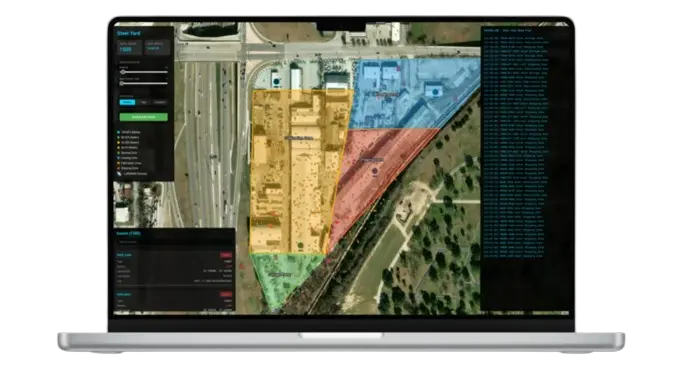
Steel Yard IoT Asset Tracking - Hybrid Asset Management Platform

United States11 months

Engineered a hybrid LoRa+GPS and BLE AoA asset-tracking platform for a US manufacturer, cutting asset retrieval from up to 45 minutes to under one minute and deploying 1,500+ tags with multi-year battery life.

FAQ

  • Fleet GPS positions, IoT sensor feeds, PostgreSQL/​MySQL tables, REST APIs, WebSocket streams, CSV/​JSON files. We design the data ingestion layer in the Diagnostic Architecture Audit to match your sources. Live data (sub-second) uses WebSocket or SSE; batch data (minutes) polls.

  • Kepler.gl (Deck.gl/​WebGL) — handles 100K+ points, heatmap, hexbin, arc, cluster, and point layers, smooth viewport navigation. Non-geospatial operations can integrate Grafana or custom chart layers. Framing is scoped in the Diagnostic Architecture Audit.

  • The AI produces typed JSON commands ({type: "filter_fleet", params: {zone: "northeast"}}) against a fixed schema of 12–20 types. Invalid types are dropped by the parse pipeline — the AI can’t invent a command that doesn’t exist in the schema.

  • Kepler.gl renders 100K+ points client-side via WebGL. The Rust backend handles concurrent connections and real-time data pushes. We profile your data volume in the Diagnostic Architecture Audit and right-size the backend accordingly.

  • Yes. The backend supports concurrent sessions. Each operator has an isolated chat history; the map state can be shared (shared awareness) or per-session (individual views). We scope the multi-operator model in the Diagnostic Architecture Audit.

  • We deploy to your infrastructure — Kubernetes, Docker Compose, or bare server (Hetzner, AWS, GCP, Azure). We deliver Dockerfile, k8s manifests, and a documented redeploy process. Database is PostgreSQL. Two services: Rust backend + static frontend.

  • We build the integration layer. If your sources have REST APIs or direct database access, we wire them. Proprietary protocols or legacy systems are scoped in the Diagnostic Architecture Audit and factored into the build timeline.

  • The five-day Diagnostic Architecture Audit delivers the architecture and command schema. A first live data source on the map follows in 10–15 days; the full system timeline depends on your data sources.

  • You own the system — full source code, database schema, deployment configuration, and runbook. Ongoing support, feature expansion, and team onboarding are available as separate engagements.

  • Yes. NDA before project start. Signed contracts with fixed scope per phase. Wyoming LLC — you’re contracting with a registered entity, not an individual.

Book a free call

Consult with our engineering team to define the perfect solution for your needs.

Book a call
30 minutes